28 Years Later (2025)
Continuing on with my backlog of review posts, I’ll be talking about the recently released 28 Years Later (2025). I saw the film a little over a week ago on Saturday 6/28/25. On that weekend, I made plans to watch M3GAN 2.0 (2025) with friends on Sunday 6/29/25. However, I had interest in watching 28 Years, particularly after watching the original film for the first time earlier that week. As such, I elected to watch it on my own at “The Ciney” in Victorville; if memory serves, it was the second showtime for the day at 10:10am. I had a light breakfast, got ready and made my way to the screening. After the movie, I went to the Barnes and Noble in the mall adjacent to “The Ciney”. The Criterion Collection summer sale had just started, so I picked up a few films. My haul included films such as David Lynch’s Blue Velvet (1986) and Akira Kurosawa’s Seven Samurai (1954). As I mentioned in my Eraserhead post, I do wish to see more David Lynch films and Blue Velvet is next in line for me in his filmography. As for Seven Samurai, I may be outing myself as a fake film fan to some when I say I have never seen a Kurosawa picture. As such, I’ll be rectifying that in the future with what seems to be his most accessible, if long ahh hell, feature. The bulk of my haul actually consists of Mexican and Chicano Cinema, including La Bamba (1987) which I’ll be writing about in due time.
In regards to my viewing experience at “The Ciney”, I sat at the top row to see if I could write on my phone during the trailers without disturbing anyone else. Unfortunately, an older couple came in shortly after I took my seat so I didn’t take any notes before or after the film. In addition, the seat that I reserved, as well as the two to the right & left of me were not able to recline, so I was locked-in for this viewing. As far as trailers go, the only two that stuck out enough for me to remember were the Ethan Coen and Tricia Cooke collab Honey Don’t (2025) and Ari Aster’s Eddington (2025), both of which I’m interested in seeing.
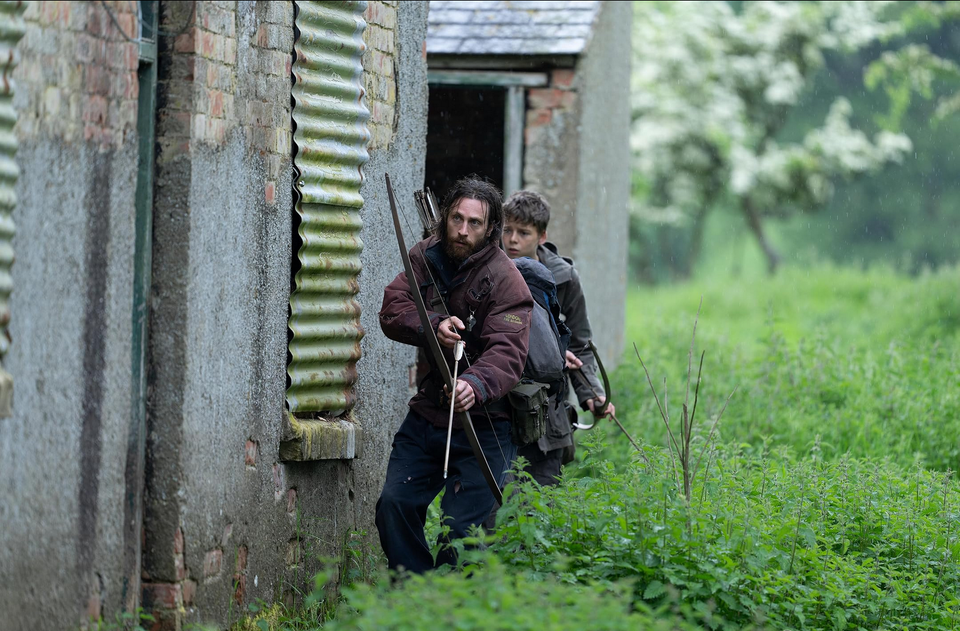
28 Years Later is a zombie (or post-apocalyptic horror if you ask Danny Boyle) film that is the third in the 28 Days franchise. 28 Years also marks the collaborative return of director Danny Boyle, writer Alex Garland, and cinematographer Anthony Dod Mantle (the trio having not worked on the 2007 28 Weeks Later). In this film, we primarily follow a family living among a community of survivors on a small tidal island away from the British Mainland, still under international quarantine from the Rage Virus that ravaged the country 28 years prior. The family consists of scavenger dad, Jamie (Aaron Taylor-Johnson), ailing mother Isla (Jodie Comer), and their young son Spike (Alfie Williams). After Spike becomes frustrated with his mother’s condition as well as his father’s apparent ambivalence to the situation, he secretly takes Isla to the mainland in hopes of finding a doctor that can help her.
Now you’ll have to forgive me here as I didn’t take any notes after the film. Moreover, since seeing it last week, I watched 3 other movies for the first time that I do have more formed thoughts on, so forgive me if I’m going more off of how I vibed with 28 Years Later. I really enjoy the look of this film. From what I read, this film was primarily shot on-location using areas in north England. From the rustic survivors island to the lush green reclamation of nature in the mainland, I love that the primary locations for each act in the film have distinct looks (from a production design and color-grading perspective). From a behind the scenes standpoint, I like that 28 Years Later echoes the 2002 original in how a decent amount of sequences were shot using smartphones, the iPhone 15 Pro Max to be exact. Similar to the Canon XL-1 camcorders in 28 Days Later, using iPhones allowed the crew to be more lightweight and versatile in their location shoots. Danny Boyle himself states that this kind of setup was key to minimize their impact on the more rural environments to provide a more naturalistic appearance. However, while the use of smartphone cameras may allow for ease in maneuverability and clever rigs to achieve stylish sequences, some may find that the picture quality may not be up to par with other big budget films. I myself was able to recall some discrepancies, particularly in the darker moments of the film, but it certainly didn’t bother me. It’s not the same as going back to watch 28 Days Later on a big 4K TV for example.
As for the non-production related qualities of the movie, I’d say that, just like the original, the performances are strong and the humanistic themes & social commentary are compelling to watch. My highlights go to Alfie Williams in his feature debut as Spike and Ralph Fiennes as Kelson. The film is ultimately a coming of age story centered around Spike and I feel that Williams does a terrific job in carrying the movie alongside Jodie Conner as their characters enter the mainland. Moreover, without getting into spoilers, Fiennes as Kelson is a character that should on paper seem like a nutjob from another generic zombie flick, but is ultimately the key in a tonal shift between the 2nd and 3rd act that I adore. The scenes involving his character and the location he’s based at are somber, yet beautiful and honestly moved me enough to feel a little emotional. Moreover, his character also highlights some social commentary. Before the audience is introduced to Kelson, we hear about him negatively from the perspective of the island survivors. This contributes to a throughline that I perceived about the kind of behaviors and activities we as people deem permissible when done as a group (or a society if you will), while dismissing or vilifying what people do either individually or outside of said society. If one were to read into this a little more, you could potentially flag this as a critique on xenophobia or commentary on a post-covid, post-Brexit United Kingdom, but that’s above my pay grade for the purposes of this post. Now I did mention that I enjoyed the tonal shift in this film, however, there is a second tonal shift at the very end that I wasn’t fond of. As best as I can describe it without spoiling the film, the final scene is honestly more a tonal whiplash than a shift in how it sets up for a sequel. At the time of viewing, I was not aware that a sequel was being shot back-to-back, X (2022) & Pearl (2022) style, and set to be released next year. With that context in mind, the ending makes more sense, but I feel that it compromises the vibe of the previous scenes in the process. Nevertheless, it would be interesting to see how the sequel may distinguish itself in tone and/or style from this film, similar to how the films in the X Trilogy did.
Gripes with the final scene aside, I’ll give 28 Years Later a Best Movie Ever. I like how this movie can stand on its own from 28 Days Later from a thematic and story perspective, while also being an evolved sequel from a production perspective. For my next post, I am still working through my backlog that now includes Superman: The Movie (1978) that I watched yesterday in preparation for James Gunn’s Superman (2025). Have a good night.